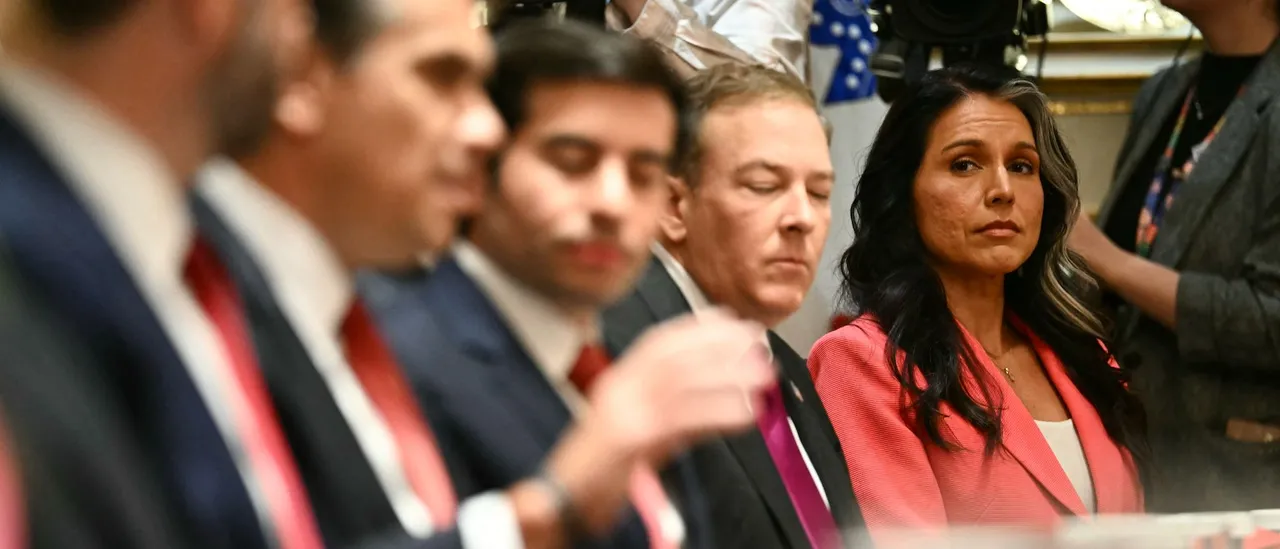
Tulsi Gabbard Called It From The Start
President Donald Trump allegedly ignored warnings from the intelligence community, military leaders, and then-Director of National Intelligence (DNI) Tulsi Gabbard about the downsides of war with Iran, according to a new Wall Street Journal (WSJ) report published Tuesday.
Read more Kim, Putin Near Completion Of First-Ever Road Link As Military Partnership Grows
Trump asked Gabbard whether the U.S. should go to war with Iran just days before he launched Operation Epic Fury on Feb. 28, WSJ reported. Gabbard, who later resigned in May, reportedly warned against it, citing assessments from the intel community. (RELATED: Tulsi Gabbard Resigns As Director Of National Intelligence)
According to the WSJ, Gabbard told the president that assassinating Iran’s Supreme Leader, Ali Khamenei, would likely make the regime more idologically hardlined and willing to acquire nukes. Tehran would also be liable to close the Strait of Hormuz immediately and begin assailing U.S. forces and bases along with America’s partners in the Middle East.
Gabbard’s warning proved prescient.
Citing U.S. officials and experts, The Washington Post reported in July that Iran’s regime had become more “entrenched and hard-line” with a new generation of non-civilian leaders.
Raz Zimmt of the Institute for National Security Studies in Israel told the outlet that after months of strikes, harsher sanctions and the U.S. blockade, Iran might be “weaker” economically but “the bottom line is that we are facing a new, bolder, self-confident Iran.”
Other experts warned that Trump’s general approach to the war and his threats to wipe out Iranian civilization have strengthened the hard-liners’ position.
Since the war’s outbreak, Iran has restricted passage through the Strait of Hormuz, disrupting global energy markets and triggering spikes in the price of oil, gas and diesel in the U.S. Maritime security groups warn that the operating environment is still tense and dangerous, despite Trump declaring Tuesday the main lane through the chokepoint has been cleared of all mines.
Iranian strikes also reportedly hit dozens of targets across 15 to 20 U.S. military and intelligence installations throughout Qatar, Bahrain, Jordan, Iraq, the United Arab Emirates and Saudi Arabia. The targets included aircraft hangars, runways, high-end radar systems, anti-ballistic missile batteries, and other logistics hubs. Repairing the damage will cost the U.S. billions of dollars, according to an NBC News report Tuesday.
Gabbard has had no shortage of Republican critics, particularly among the GOP’s hawks and members of the Washington, D.C., political class.
Before her confirmation in 2025, National Review’s editorial board described Gabbard as an “atrocious nominee” with “an extensive record of poor judgment” and “bizarre strategic misjudgments.”
In late 2024, The Guardian reported that the D.C. foreign policy establishment and intel community believed Gabbard was “dangerous” and “inclined toward conspiracy theories and cozying up to dictators.”
Just two weeks into the war, conservative radio host Erick Erickson claimed that Gabbard and other “isolationists” within the administration were trying to undermine the president.
“The fact of the matter is, however, we have kicked this nest of hornets, and we have to get rid of the hornets, or they’re going to keep stinging us now,” he said in early March. “We need to see this through. The idea that it would take three weeks — a country the size of Alaska — has always been nonsense. The idea that we’re caught off guard by what Iran is doing is absolute nonsense. This is an internal struggle within the Trump administration by the isolationists and Democrats in Congress to try to sabotage a military campaign against a terrorist nation that’s been killing us for 49 years.”
Gabbard drew the ire of hawkish Republicans, including Mark Levin, and the Trump administration itself in 2025, after she posted a video warning of nuclear war right as Trump was weighing whether to join Israel’s strikes on Iran. Gabbard said in the video that the “political elite and warmongers” were “carelessly fomenting fear and tensions between nuclear powers.”
A senior Trump administration official told Politico at the time that the president perceived Gabbard’s video as a backhanded attempt to steer the government’s decision.
The U.S. ultimately bombed Iran’s Fordow, Natanz and Isfahan nuclear sites June 21, 2025, in what was dubbed “Operation Midnight Hammer.”
“I don’t think he dislikes Tulsi as a person … But certainly the video made him not super hot on her … and he doesn’t like it when people are off message,” the official told Politico, adding that the president also does not appreciate it when someone seems to be correcting him.
“Many took that video as trying to correct the administration’s position,” the official said.
Read more What Do Trump’s 2024 Swing Voters Want From Him Now?






Post Comment