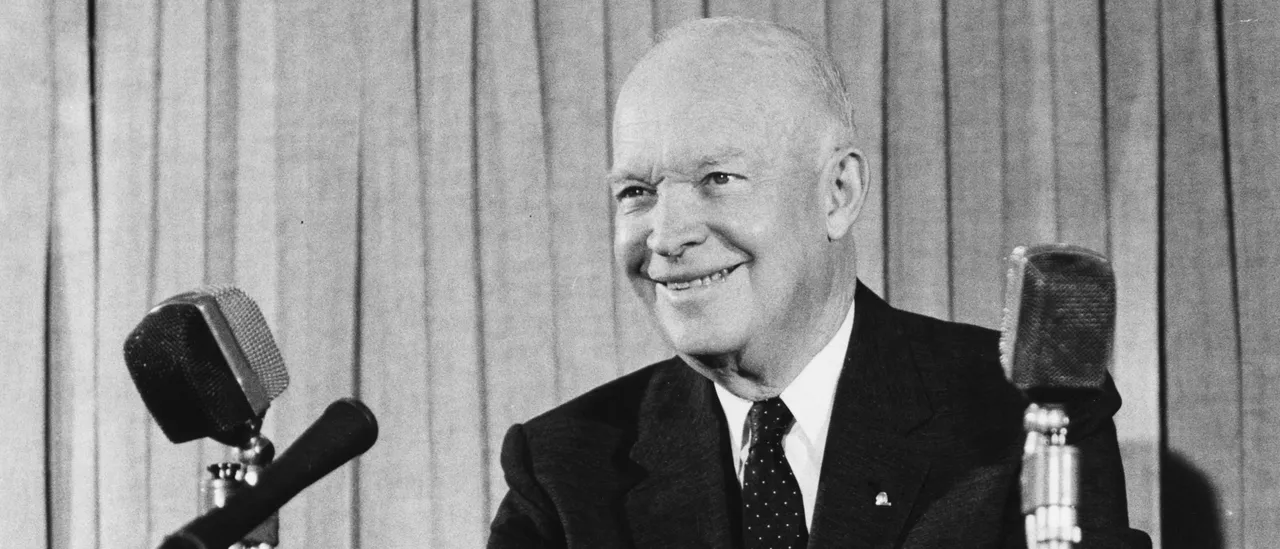
When The US Ordered Israel To Stop And Tel Aviv Listened
October 1956 — President Dwight D. Eisenhower picks up the rotary phone on his mahogany desk. He reportedly consumes up to 24 cups of coffee a day during high-stakes crises such as this. He is furious. British Prime Minister Anthony Eden has attacked Egypt alongside France and Israel to reclaim the Suez Canal.
Read more Tucker Carlson Clarifies He Hasn’t Endorsed Anyone In Abdul El-Sayed Race
Today, many assume that the post-WWII era — a time of historic, record-high American church attendance — meant automatic, unconditional U.S. backing for the nascent Jewish state. But this is far from reality. In 1956, the institutionalized “special relationship” that dictates foreign policy today did not exist. Washington did not view Israel as a high priority, seeing it instead as a small, fragile, frontier state. The horrors of Nazi atrocities were fresh, yes, but they had not yet translated into military or foreign policy priorities. The political powerhouse of Christian Zionism had not yet emerged.
Eisenhower’s strategy was simple: deter the Soviet Union and protect vital oil reserves. To understand where priorities actually lay, look no further than Billy Graham, one of the best-known pastors of the era and a confidante of Eisenhower. That same year, Graham founded Christianity Today to give evangelicals a voice. Yet, during the height of the Suez Crisis, neither Graham nor his publication lobbied the White House to intervene on behalf of Israel. The evangelical focus was anchored in personal salvation and defeating communist atheism at home.
For the 1956 churchgoer, the fact that Jesus was a Jew carried no political weight; they simply did not believe they had a religious obligation to support an ethnic group or a modern secular state in a twentieth-century land dispute.
So, while secular Israeli leaders like PM Benjamin Netanyahu or Permanent Representative to the UN Danny Danon frequently quote the Bible to justify geopolitical actions today, you did not have 1950s pastors rallying congregants to support Israel during Sunday sermons. Even Secretary of State John Foster Dulles — a deeply devout Presbyterian — viewed the crisis strictly through the lens of containment. Siding with old European colonial empires would make America look like a defender of imperialism to a sea of newly decolonized nations. Worse, the Suez invasion occurred the exact same week Soviet tanks rolled into Budapest to brutally crush the Hungarian Revolution.
Eisenhower felt the U.S. could not maintain the moral high ground against Moscow if it concurrently condoned a Western-led blitzkrieg against Egypt. But what fueled the president’s ire to the maximum was the blatant deception. The deliberately kept the operation a complete secret from Washington. They timed the attack for just days before the U.S. Presidential Election, gambling that Eisenhower would be too distracted by the ballot box to intervene. But they miscalculated. Eisenhower resented being manipulated.
Asserting that American foreign interests would not be compromised, he applied brutal financial leverage, threatening to sell off U.S. holdings of the British pound — a move that would bring forth the collapse of Britain’s economy.
The trio blinked. Israel, France, and the UK withdrew. This stands in total, stark contrast to the modern era, where Washington routinely deploys UN vetoes, tariffs, and sanctions to unconditionally defend Israeli actions, even amidst ongoing ceasefire violations and breaches of international law.
The game-changing pivot happened only after the 1967 Six-Day War, when Israel single-handedly defeated Soviet-backed Arab armies and instantly transformed into an invaluable anti-communist proxy. This strategic shift later amalgamated with burgeoning evangelical end-times doctrine to become the paradigm we see today. Billy Graham began advocating for Israel only after this occurred. Furthermore, in 1956, Holocaust memory did not occupy the cultural centerpiece it does now. This was due to cultural avoidance and Hollywood censorship rules called the Motion Picture Production Code, or Hays Code, under which violence and nudity (portraying people in concentration camps) were barred. So, such atrocities were rarely depicted on screen. Films of the era were also more focused on escapism rather than processing trauma, and dedicated Holocaust museums did not yet exist — the first such museum opened in Los Angeles in 1961.
Secretary Dulles later estimated that 90% of the mail the administration received protesting its pressure on Israel came from American Jewish groups — very little came from Christians.
Flash-forward to President Donald Trump moving the U.S. Embassy to Jerusalem in 2017, openly stating, “That’s for the evangelicals.” Another example is U.S. Ambassador to Israel Mike Huckabee, who frequently cites foreign policy decisions as coming directly from God’s promise to Abraham.
During his Senate confirmation hearings, Secretary of War Pete Hegseth explicitly identified as a Christian Zionist. Rather than keeping military decisions strictly secular, as Eisenhower did, Hegseth leaned heavily into religious framing during conflicts with Iran, proclaiming at a Pentagon briefing that U.S. service members carried out duties “under the protection of divine providence.”
These modern appointments signal a complete flip of the 1956 reality, where Eisenhower’s White House ran on national interest, completely unswayed by millenarian dynamics. Eisenhower went on to win the 1956 election in a historic landslide, capturing 57.4% of the vote and garnering a majority in 41 states. His fierce opposition to the invasion was not an electoral liability among the Christian majority, apparently.
Peering into the historical lessons of the Suez Crisis, we see how drastically U.S. foreign policy has shifted. The so-called unbreakable geopolitical bond of today is neither an ancient Christian obligation nor a permanent baseline of American history. It is a highly constructed byproduct of the late twentieth century — leaving one to ponder if the clear-eyed, reality-grounded statecraft of Eisenhower’s 1956 White House is exactly what Washington needs right now.
Avi Kumar is a freelance journalist of Sri Lankan origin who has lived in many places and speaks 11 languages. He writes about world affairs.
The views and opinions expressed in this commentary are those of the author and do not reflect the official position of the Daily Caller.
Read more It’s Only September, And We Already Have Our Craziest Finish Of The College Football Season











Post Comment