EXCLUSIVE: They Haven’t Had Water For Years. An Influential Republican Politician May Be To Blame
Tammy Cramer remembers when her grandchildren spent their summers pushing each other into Cedar Lake from the inflatable island anchored near their dock. The water was crystal clear then — so clear that the kids could look down and see perch nipping at their toes beneath the surface.
Read more Mystery Chemical Leak Forces Toledo Residents From Homes As Hazmat Crews Scramble
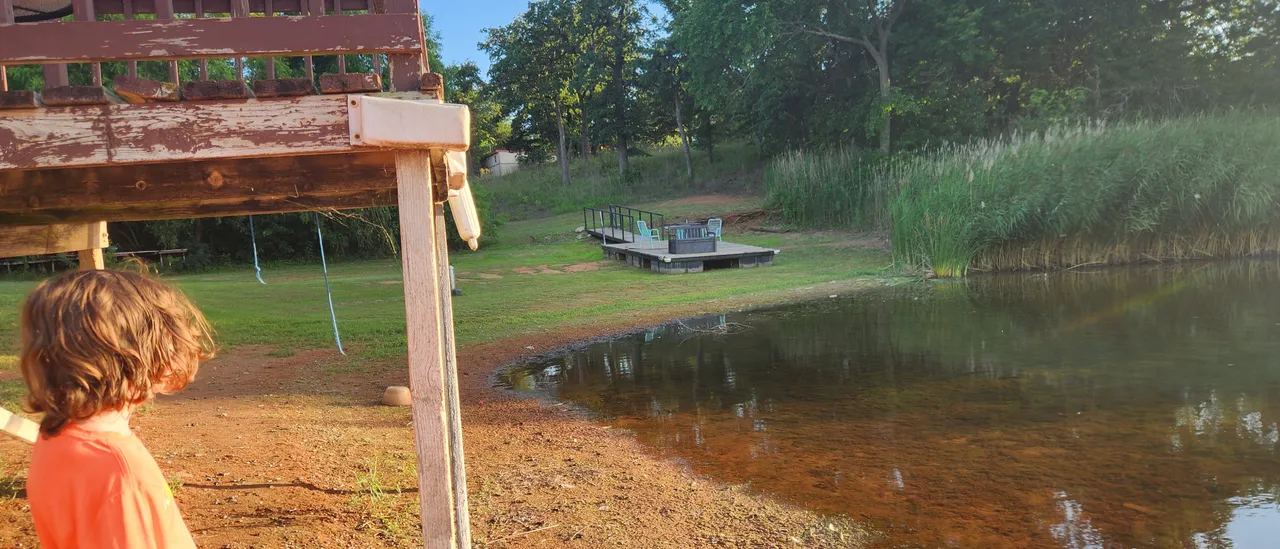
Now, Cramer sinks past her ankles in slimy muck when she tries to walk out into the lake. Her floating dock rests on the dirt and is infested with bugs. The last time Cramer’s son and several of her grandchildren tried to swim in the water — about a year ago — they got sick. Cramer blames the worsening water quality and refuses to swim.
Cedar Lake, a moderately sized reservoir with an estimated storage capacity of 1,000 acre-feet, was created in the 1950s when the Western Sportsman Club dammed a tributary to the Canadian River in central Oklahoma, according to a surface water application obtained by the Caller and an Oklahoma Water Resources Board (OWRB) webpage.
Residents describe the gated lakeside community, located about 50 miles west of Oklahoma City, as small but tight-knit: only about 400 people lived there in 2020, according to the U.S. Census Bureau. Cramer appreciates the friendly neighborhood, where people help each other without expecting anything in return.
Yet now, many residents say the home they love is slowly being destroyed. According to pictures of Cramer’s dock taken in 2019 and 2026, Cedar Lake levels appear feet lower than they were seven years ago. Other images show docks feet away from the water. Some residents say their dried-up wells do not provide the water they need for everyday life.
Residents like Cramer blame an unpermitted dam located on land managed by former Oklahoma Secretary of State Glenn Coffee.
Coffee has long been a prominent figure in Oklahoma politics. He served in the state Senate for 12 years before Republican Governor Mary Fallin named him Oklahoma secretary of state in 2011. Coffee began serving as senior advisor to the Oklahoma State Senate in 2025.
Now, some Cedar Lake residents blame “Coffee Dam No. 6” for their dwindling water supply, alleging the politically connected lawyer is retaining streamflow that should be reaching their community. (RELATED: Meet The ‘Rogue’ FBI Bureaucrat Who Said She Ran A ‘Shadow Government’)
A spokesperson for the OWRB, the state agency that oversees water rights, told the Caller the agency investigated the situation. In a summary of its findings, the OWRB pointed to drought, an overused aquifer and the Western Sportsman Club’s original assessment that streamflow would be insufficient to maintain Cedar Lake. The OWRB approved a consent order in September that requires Coffee to apply for permits for several dams — but does not resolve problems at Cedar Lake.
“Based on the investigation, OWRB staff is unable to determine that the lowered water levels in Cedar Lake are related to the construction of the upstream dams,” the OWRB told the Caller.
Hydrologist Carol Becker, who has worked with Oklahoma water systems for more than 35 years, reached a different conclusion. Her July report identified the two upstream dams as the primary cause of Cedar Lake’s declining water levels. The OWRB declined to comment when the Caller asked about this report.
Coffee also has longstanding ties to the OWRB. He served as counsel for the agency in two major water-rights cases settled in 2016, to court . In 2006, while serving in the state Senate, Coffee also appointed current OWRB member Ron Justice as co-chair of the Senate Agriculture Committee.
Neither Coffee nor his attorney responded to multiple requests for comment.
The Caller spoke with nearly a dozen Cedar Lake residents and property owners, both on the record and on background, reviewed OWRB documents and consulted legal experts and hydrologists.
The Problem Begins
Cedar Lake resident Kacee Corey first noticed the lake level dropping about five years ago. She joked about it with friends — until the cove around her family’s dock dried up and filled with brush.
“[I]t just kept going down and down,” Corey said. “And now there’s just nothing but trees.”
Belinda Smith moved to a rental property near Cedar Lake three years ago, drawn to the quiet of the secluded community. But within months, the 70-year-old began finding sand in her water. Then her well went dry. Her landlord flushed the well in an attempt to restore the flow, but the water never returned.
Smith’s doctors have warned her not to exert herself, and she describes herself as “bent halfway over” from scoliosis. Hauling water supplied by a friend is difficult.
“It’s hard to pick up the five-gallon jug,” Smith said.
After her well went dry, Smith began dreading mornings, when she had to pour and heat water before carrying it to the bathroom or sink.
Smith is far from alone. Becker’s report included a May and June 2026 survey of Cedar Lake residents conducted online and through word of mouth. Among 63 responses, 20 wells were reported as completely or seasonally dry, 29 as providing limited water, and 10 as reliable. Of 35 respondents who answered a separate question about timing, 34 said their water problems began after 2021.
The OWRB began its investigation after it received an anonymous complaint requesting the removal of Coffee Dam No. 6 in May 2025, according to an OWRB consent order.
Weeks later, OWRB staffers inspected Coffee Dam No. 6 and determined it fell under the agency’s jurisdiction, according to a document obtained by the Caller. The dam stands an estimated 33 feet tall and can hold up to roughly 119 acre-feet of water — nearly 60 Olympic swimming pools.
The OWRB told the Daily Caller the dam was constructed in 2019, roughly three years before residents surveyed by Becker began reporting water problems.
The agency found no “applications or valid permits” for the dam in its records, according to an OWRB document obtained by the Caller. In July 2025, the agency directed Coffee to submit a belated application to construct the dam, or apply to remove or downsize it.
Coffee hired Fox Engineering to prepare an application, setting off months of negotiations and further OWRB review. During its preliminary investigation, the agency identified five other dams on property managed by Coffee that appeared to fall under its jurisdiction and lacked permits issued before construction.
Several property owners fear potential flooding shown on an OWRB map reviewed by the Caller, which depicts what could happen if Coffee Dam No. 6 failed. The agency has not yet classified the dam’s hazard level, though inspectors described it as being in “fair” condition during a June 2025 visit. The OWRB told the Caller that the dams upstream from Cedar Lake do not “pose a risk to public safety.”
OWRB staff visited Cedar Lake twice in late 2025 to investigate residents’ concerns, records show. During an October visit, staff estimated the lake was between 3.5 and four feet below normal. The agency’s investigation summary now places it seven feet below normal pool elevation.
Some residents believe the decline is even greater. Erik Carlson, whose seven-foot-tall dock now sits completely out of the water, estimated in July that the lake near his property has dropped “easily” 11 to 12 feet.
Carlson initially wasn’t concerned when water levels began dropping, since droughts often cause lakes to ebb and flow. He started worrying after eight inches of rain fell and the water continued receding instead of rising.
“It doesn’t matter how much it rains,” Carlson said. “It just didn’t make any sense.”
Carlson’s 10-year-old son got his first kayak last summer. Carlson once treasured quiet mornings on the lake with his son, surrounded only by birds and fog. Now, he says, that sense of peace is gone.
“It’s replaced with a feeling of just a sickness, of seeing where there was something beautiful, and now it’s mud,” Carlson said.
Expert Evaluation
Becker, a former hydrologist for the U.S. Geological Survey’s Oklahoma-Texas Water Science Center, told the Caller she prepared her report at no charge after Cedar Lake residents approached her about the declining water levels.
Two tributaries feed Cedar Lake within a relatively small watershed. Becker’s analysis found that Coffee Dams No. 5 and No. 6 capture runoff from nearly 40 percent of the watershed — what she called “a tremendous amount.”
“It’s quite obvious to me what’s going on,” Becker said. “I mean, when you capture runoff from 40 percent of the watershed and impound it behind dams and don’t allow it downstream to the lake, you know, lake water level drops ten feet. The aquifer is not recharged. Wells go dry.”
Cramer’s grandfather purchased property at Cedar Lake in 1957. She remembers when the stream feeding one of the lake’s coves was four to six feet wide. Now, she says, it is barely a foot across. (RELATED: 8-Year-Old Fisherman Bizarrely Catches Piranha In Pennsylvania Lake)
Cramer believes that is no longer enough to offset evaporation during drought.
Groundwater depletion occurs when water is withdrawn faster than it can naturally be replenished and can contribute to declining wells and surface-water levels, according to the USGS.
Two of nine Cedar Lake wells inspected by the OWRB in June 2025 failed to meet agency criteria, according to a groundwater inspection report obtained by the Caller. The agency described the area’s wells as generally shallow, old, and in poor condition, and estimated that 250 to 400 wells may be clustered around Cedar Lake.
The OWRB argues that the large number of domestic wells surrounding Cedar Lake is more likely to have caused the depleted aquifer and low lake levels.
Becker counters that Cedar Lake’s aquifer supported the community’s wells for decades without widespread reports of water shortages.
“Only after the construction of two dams in the upper part of the watershed have residents reported noticeable declines in well yield and water availability,” she wrote.
Dr. Ali Mirchi, associate director of the Oklahoma Water Resources Center, told the Caller that multiple wells drying up over a short period can be a “red flag.”
“There’s definitely a cause of concern,” Mirchi said.
The OWRB points to drought as a possible contributor. Canadian County experienced severe drought each year from 2021 through 2024 and extreme drought in 2026, according to the OWRB’s investigation summary. The agency noted that Cedar Lake rose 3.6 feet during a wet period in 2025.
The OWRB also found that declining lake levels tracked falling groundwater levels. Its summary described Cedar Lake’s small watershed as a “major limitation,” noting that “unreliable flow increases drought vulnerability.”
Mirchi emphasized that prolonged droughts would exacerbate Cedar Lake’s situation. After reviewing an OWRB presentation, he also admitted the agency might be correct that reduced runoff is not the main cause of declining water levels.
But he added that any reduction to runoff could worsen existing problems.
Becker acknowledged that drought can temporarily reduce both streamflow and groundwater levels, but argued that the drought alone does not explain the scale of Cedar Lake’s decline.
Read more Country Music Legend John Anderson Dead At 71
After reviewing Becker’s report and the OWRB presentation, Mirchi suggested that “additional hydrologic modeling of the system” could help determine how much the lake responds to runoff captured upstream and how much it relies on other factors.
According To The Law
Residents interviewed by the Caller repeatedly argued that they have rights to some of the water being held behind Coffee Dam No. 6. Many accuse Coffee of unlawfully retaining water they say is desperately needed by elderly and low-income neighbors.
“I would have thought the Water Resources would have handled it according to the law. And according to the law, we have the rights to that water,” Cramer said.
But it might not be so simple.
Cedar Lake residents do not have rights to all the streamflow feeding the reservoir. OWRB records show the Western Sportsman Club has rights to 163 acre-feet of stream water per year to offset evaporation losses.
That means Coffee’s dams could theoretically reduce the amount of water flowing toward Cedar Lake without violating the club’s rights, so long as the club still receives the amount to which it is legally entitled.
“OWRB has not observed any reduction in flow caused by Coffee Dam Nos. 5 or 6 which would constitute interference,” the OWRB told the Caller.
The OWRB also pointed to historical documents showing that the engineers who designed Cedar Lake doubted streamflow alone would be sufficient to maintain it.
“It is felt that the yield of the stream will not be sufficient to maintain a lake of the area and capacity required for their operation,” the engineers wrote, according to the OWRB’s summary.
To supplement the lake, the Western Sportsman Club obtained a permit allowing it to use 482 acre-feet of groundwater. But the OWRB said it has not received annual water-use reports under that permit since 2003.
“Evaporation losses outpace streamflow and runoff during drought years,” the agency’s summary report reads, especially because “backup groundwater supply to keep lake levels up has been abandoned.”
Kaylee Davis-Maddy, an attorney who has worked on Oklahoma water-law issues, said the OWRB would probably describe the state as the entity being harmed by Coffee’s unpermitted use of stream water. Stream water is a public resource under Oklahoma law, she explained.
Coffee signed four applications for prior appropriation rights this year, according to the OWRB’s summary. One seeks 65 acre-feet of water per year for “Recreation – Fishing” in “Farm Pond 6” — roughly the amount currently stored behind Coffee Dam No. 6. The application indicates the water was already being used when Coffee sought the permit, triggering a doubled $1,000 filing fee.
Applicants must identify all “known or easily discoverable” landowners whose legally protected interests could be directly and adversely affected by the proposed use of stream water. Coffee’s application listed more than 500 potentially affected addresses, including addresses associated with Cedar Lake residents.
The OWRB is currently reviewing the application.
Residents like Corey say fears of losing access to water have forced them to ration what they have. In Becker’s survey, 44 percent of respondents who answered a question about water use said they relied on well water for all household needs, including cooking and bathing.
Smith still cannot run her washing machine and has resorted to camping showers because a $17 shower at a nearby truck stop is too expensive on her limited budget.
But Davis-Maddy noted that Oklahoma law treats groundwater and surface-water rights separately, which could make it difficult for residents to challenge Coffee’s surface-water use based on harm to their wells.
“You are not going to stop someone from getting a permit for surface water by saying, my wells are drying from what they’re doing,” Davis-Maddy said.
The attorney formerly representing Cedar Lake residents, Tim Sowecke, declined to comment.
Questions Of Influence
About 50 Cedar Lake residents and property owners flooded into the Oklahoma Judicial Center on September 15 to oppose a consent order between the agency and Coffee. The order, which Coffee had signed in July, was intended to resolve regulatory issues involving his dams.
The 10-page order references the anonymous May 2025 complaint but does not detail Cedar Lake residents’ water problems. It would require Coffee to pay a $2,500 fine and submit construction applications for four dams. It does not require removal of Dam No. 6, instead citing the possibility of “flooding which Coffee Dam No. 6 now acts to contain.”
The OWRB told the Caller it had no documentation of dangerous flooding in the stream system before the dam was built.
The Board approved the consent order in a single vote on a summary docket of about 80 other business items, according to KOSU.
Attendees at OWRB meetings can request that an item be considered individually after the vote on a summary docket is introduced. Mark Sullivan, a Cedar Lake property owner, headed toward the podium to ask the Board to consider the consent order separately. But the Board finished voting on the docket about 40 seconds after it was introduced — and about four seconds before Sullivan reached the stage, according to KOSU.
Sullivan, who described himself as hearing impaired, told the Caller he had struggled to hear what was happening over the audio systems. But acting OWRB Chairman Bob Latham refused to consider his request, the outlet reported.
“He said, well, it’s too late. … We’ve already voted,” Sullivan told the Caller. “I just looked at him, and I said, ’ Is this the way you want to do this? And he just looked at me and said, ’ We’re moving to the next item.’”
The OWRB continued with the agenda as Sullivan and other frustrated Cedar Lake residents left.
Coffee said at a mid-September press conference that he felt for the owners of Cedar Lake, according to KFOR Oklahoma City. But he added that “neither the facts, nor the science, nor the law” supported the outcome Cedar Lake was hoping for.
He said his family was willing to put $100,000 toward developing a rural water district for Cedar Lake — if they promised not to sue him and contributed $300,000 of their own, the Oklahoma Voice reported.
Some residents question whether Coffee’s political connections have affected the process and why the OWRB has taken so long to address their complaints.
Coffee’s original deadline to submit a construction application for Dam No. 6 was Aug. 31, 2025, according to OWRB records. The agency has since extended the deadline three times, with the approved consent order giving him until Nov. 30, 2026, to submit an updated application.
The OWRB’s entire board has turned over since Coffee represented the agency and the state in two water-rights cases in 2016. However, some senior agency officials remain, including General Counsel Sara Gibson and Executive Director Julie Cunningham.
Coffee may have also been implicated in questionable situations during his time in Oklahoma government. He advocated for private prisons as President Pro Tempore of the Oklahoma Senate in 2009 — during the same time period when then-Oklahoma Senate Senior Policy Advisor Fred Morgan vacationed with a private prison lobbyist in December 2008, according to The Journal Record. (RELATED: Oklahoma Advances Bill To Turn Dead Humans Into Actual Fertilizer)
Coffee subsequently defended Morgan’s actions, calling protests against it a “cheap shot.” The outlet reported that the lobbyist’s wife had previously fundraised for Coffee.
During Coffee’s term as Oklahoma Secretary of State, the Fallin administration faced similar outcry over alleged corruption surrounding the private prison industry. Some of Fallin’s senior advisors contributed to efforts to weaken the state’s Justice Reinvestment Initiative, designed to reduce the state’s prison population, according to Oklahoma Watch.
While the Watch did not implicate Coffee in these efforts, he was still advocating for private prisons around this time period. Coffee called then-Oklahoma Department of Corrections Director Justin Jones in 2011 to ask Jones to call House leaders and seek approval for a bill that would increase per-inmate rates for private prisons.
Some Cedar Lake residents believe Coffee’s efforts to retain his dams stem from corruption.
“I’m very disappointed. I’m a lifelong Oklahoman, and I’ve believed in our system.And I believe the OWRB has failed us,” Sullivan said. “It looks like that they were trying to cover for a rich, powerful, politically connected individual.”
“[It’s] definitely political and a money thing,” Corey said. “I’m curious, what else is there that he wants?”
‘Like Another Death’
For Cedar Lake residents, the falling water levels are deeply personal.
“It’s like another death,” Corey said.
She said her dreams of spending days on the lake with her children and grandchildren have faded. They rarely want to visit anymore, and when the kids tried to swim over the Fourth of July, they came out covered in sand.
Davis-Maddy said one option may be for Cedar Lake residents to seek additional surface-water rights from the OWRB.
But many residents say they do not know what to do next. Some have invested heavily in their properties but would consider leaving if water levels keep falling. Others, including Smith, cannot afford to leave — or hire a lawyer.
Neighbors recently connected a roughly 250-gallon water tote to Smith’s house, giving her a limited supply. The tote must be periodically refilled, and Smith uses the water sparingly. She still takes her clothes to a laundromat because the tote does not provide enough pressure to run her washing machine.
“God’s good,” she said. “I believe He’ll help these people here because we sure need it.”
Cramer still cherishes memories of crystal-clear water and her grandchildren splashing in Cedar Lake. She fears those days may be gone for good.
Read more Airbnb Finally Cracks Down On Hosts Treating Guests Like A Free Maid Service
“If they don’t make [Coffee] do right, it’s all going to be gone,” she said.












Post Comment