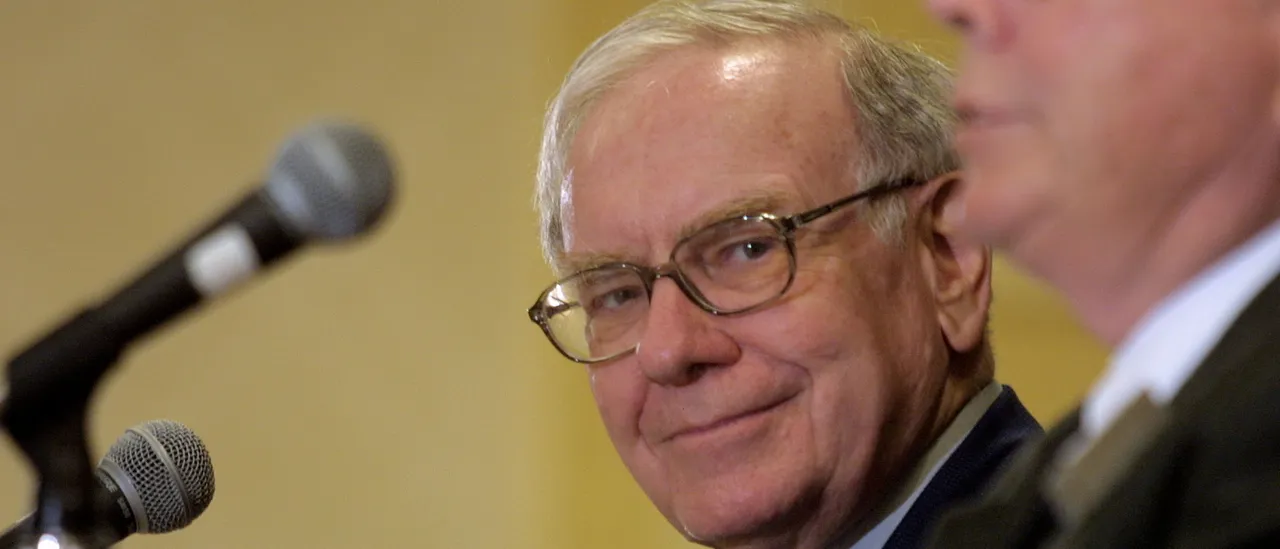
MR. RIGHT: Why Warren Buffett Never Left Home
Warren Buffett, the billionaire and former chairman of Berkshire Hathaway, once said that the home he had purchased in 1958 – the home he would stay in for the rest of his life – was the third-best investment he ever made.
Read more INGERSOLL: Here’s What’s Dominating Elite Discourse Today. Are You Exhausted Yet?
Despite his fabulous wealth and enormous success as one of America’s greatest and wisest investors, Buffett never left his hometown of Omaha, Nebraska, where he was born in 1930. In today’s world, that is quite rare. But Buffett wanted his family to be raised far from the hubbub of a dense metropolis like New York City and experience the simpler lifestyle of the Midwest. This distance also made him a better, clearer thinker. The slower pace of living, the down-to-earth neighbors, the vast tracts of farmland, all gave him emotional clarity – something you need if you want to lead a holding company as massive as Berkshire Hathaway. Thanks to the 1,200 miles that separate Omaha from Wall Street, he was never distracted by the “noise.” (RELATED: NYT Shocked EU Tourists Prefer Bass Pro Shops Over Obama Library, Museum Of LGBT Kinks)
I have always found Buffett’s decision to stay in Omaha slightly odd. The late Charlie Munger, who was Berkshire’s vice chairman, was also born in Omaha. Munger eventually settled in Pasadena, California, in the early 1950s. But like Buffett, he stayed in the first home he ever purchased and never developed a taste for the large and lavish mansions he could have afforded in spades. Although its mismanagement and decline are a national disgrace, California remains the most beautiful state in the country, and its Mediterranean-esque climate is the envy of many Americans – at least the millions who are forced to brace harsh, frigid, seemingly endless winters every single year. Unless a gun were pressed to my forehead, I would pick Pasadena over Omaha, every single time. But not Buffett. Buffett stayed put. Were it not for the fact that Omaha was his hometown, his decision to stay had always seemed to me like a form of torturous self-exile. Could he not, like Munger, escape the noise of Wall Street by living on the other side of the country in the rainless, snowless groves of Southern California?
It wasn’t until a recent trip to Omaha for my wife’s friend’s wedding that I – finally – fully understood why Buffett never left.
Omaha really does make you feel an almost eerie sense of isolation. As you arrive by plane, as I did, and look out the window, all you see are checkered swatches of farmland, like a green and mustard-yellow quilt blanket. There isn’t much else. And as you roam Omaha’s downtown, sidewalks virtually empty, you feel as if you are stuck on an empty Hollywood movie set. Even though you are in a relatively big city for the Midwest, you can walk whole blocks without seeing a single person. (RELATED: Red State Notches Historic MAHA Win)
Read more China’s New Strategy For Selling Drugs to Americans
It is not for everyone, to be sure. Besides the small, historic, charming Old Market neighborhood, where you will find the restaurants, stores, and bars, most of the downtown blocks are truly desolate. If you do happen to see other people, quite a few of them are homeless, loitering outside businesses or else sleeping in doorways. There seems to be a drug problem, yet I did not see a single beat cop. When you heard sirens, it was safe to assume that the fire department was speeding in because a homeless person was unconscious or had overdosed. It reminded me of the only other Midwest city I had been to: Sioux City, Iowa, which is just 100 miles north. Sioux City is a rough, virtually empty place, as well. The only activity there revolves around a Hard Rock Cafe.
That being said, Omaha still has a magnetic charm, thanks in large part to locals who call it home. In the best possible way, Midwesterners are built differently. They are faultlessly polite, down-to-earth, and never seem to put up facades. They are earnest, and their friendliness is genuine, unlike a vast number of people you would encounter in, say, New York City or Los Angeles. They are not in a rush. They are not trying to be anywhere else than where they are. They are content. And maybe this is what Buffett was referring to when he talked about how the city gave him an “emotional clarity” that could not be found elsewhere. My interactions with locals were just that: emotionally crystal clear. It was not like reading tea leaves, trying to decipher cryptic intentions and hidden signals. Rather, it was like talking to an old friend you have not seen in a while: straightforward and easy-going.
So I get it now. I get why Buffett stayed in Omaha – and also what made him a great investor: he saw things simply and clearly, the way someone from his hometown would. As others chased glory, he spotted long-term value in overlooked, boring places. Omaha is boring, too. But that does not mean there is no value there. Buffett saw it in the lifestyle, the people, the geography. Why leave a place where you’re perfectly content?
Read more House Deals Bipartisan Blow To Trump Admin Passing Second War Powers Resolution











Post Comment