Scott Bessent Skimps On Details In Big ‘Economic D-Day’ Iran Sanctions Announcement
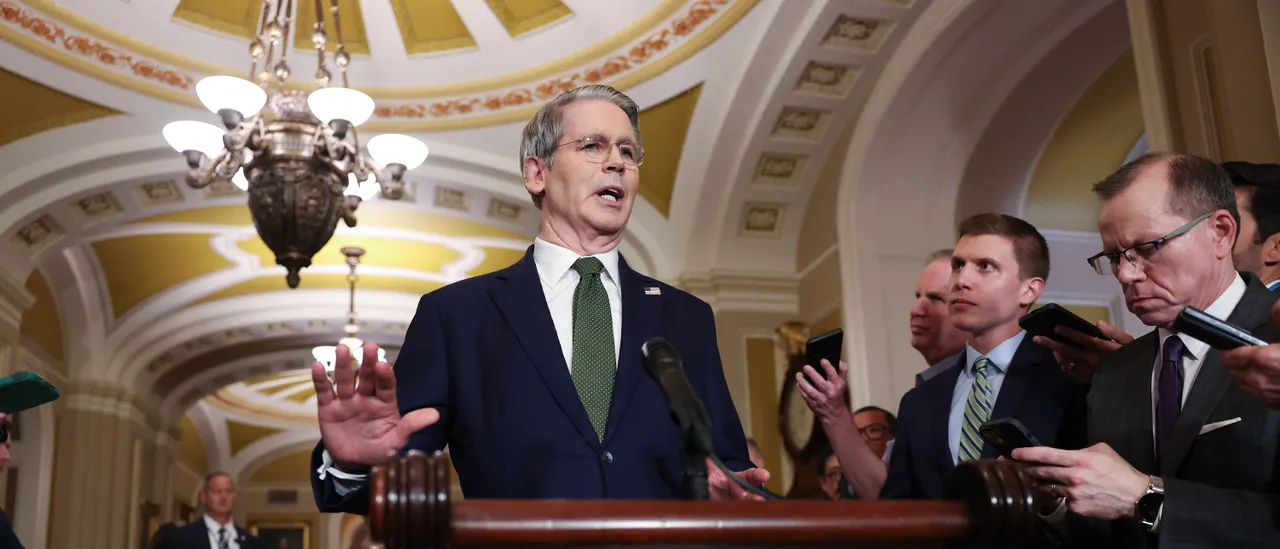
Treasury Secretary Scott Bessent provided few specifics Monday during his highly-anticipated announcement about sanctions against Iran.
Read more The Real Reasons Why You Keep Paying More For Employer Healthcare
The expanded “secondary” sanctions, which Bessent dubbed an “economic D-Day,” were intended to intensify pressure on Iran amid the current “no war, no deal” limbo. Iran faced international sanctions for years without fundamentally changing its regional behavior or its posture toward its nuclear program, raising questions about whether a broader economic squeeze would produce a different result.
“Let there be no ambiguity as to the position of the United States,” Bessent said at a Monday news conference. “An economic engagement of any kind with this murderous regime will expose those responsible to the full reach of American power.”
Bessent did not provide a deadline for compliance, but warned that the U.S. would not wait indefinitely.
“I’m not going to set a timeline, but we do not have infinite patience here,” Bessent said.
The Treasury secretary also suggested that China and other major trading partners of Iran would not be exempt from the campaign.
“No one is above this,” Bessent said when asked whether China would be targeted. “This is economic asphyxiation of this regime … and no one should test our resolve.”
The administration already maintained extensive secondary sanctions against countries that traded with Iran, particularly its oil sector, but U.S. officials only partially enforced those measures. (RELATED: Economic Alarm That Foreshadowed 2008 Crisis Is Blaring Again)
For the new pressure campaign to succeed, Washington would likely have to convince allies to participate while aggressively confronting countries including China, Russia, India, Pakistan, Qatar and Turkey that continued to maintain economic ties with Tehran.
“Today, at President Trump’s direction, the United States Treasury has begun Operation Economic Outcast, an unprecedented campaign against the Islamic Republic of Iran and its enablers,” Bessent said. “In the Second World War, D-Day marked the historic beginning of a campaign with our allies to target and drive the enemy from its positions, including those in third countries. Today, in that same spirit, we are launching an economic onslaught against Iran’s financial connections around the globe.”
Read more Disaster Struck Just Two Continents. Will We Be Ready When It Comes For Us?
The operation expanded the categories for secondary sanctions on entities and countries that performed transactions with Iran and also introduced sanctions across sectors, including digital assets, gold, aviation, technology and shipping, according to CBS News.
Bessent warned nations and entities against performing money laundering on behalf of Iran. He said anyone committing money laundering for the Iranian regime “will be removed from the U.S. dollar system.”
The Treasury secretary added that many of the sanctions wouldn’t take place immediately.
“We are giving everyone the opportunity to remedy bad behavior,” Bessent said. “Why would I want to blow up the global financial system? We believe that it is important to level set and give people a cure period, but they should know that that will move very quickly and that we are serious.”
Bessent said he expected a major financial institution would be sanctioned soon, but provided no further details, according to CBS News.
Prices for everyday necessities remained elevated following the energy shock unleashed by the conflict, while wage growth slowed to 3.2% over the past year, according to the BLS. With inflation running faster than wage growth, workers were seeing their purchasing power eroded even as the headline inflation rate began to moderate.
According to the Federal Reserve Bank consumer finance tracking, this trend forced working families to deplete savings and rely increasingly on high-interest credit cards just to maintain basic consumption levels.
Following the outbreak of military operations against Iran, energy prices surged—including a 10.9% single-month jump in March—leaving annual energy costs up 14.7%, according to.
Because energy serves as a key input across agriculture, manufacturing, logistics and utilities, elevated crude and fuel prices rapidly spread through the supply chain. This drove up costs for groceries, transportation and home heating.
Read more Pentagon Wants To Curb CCP Infiltration In America’s Universities, But There’s A Problem














Post Comment