How El Salvador Beat The Gang Problem America Still Can’t Control
In January, officials charged three criminal illegal aliens from El Salvador who were allegedly members of MS-13 with murdering a 14-year-old boy in Maryland, according to the Department of Homeland Security (DHS). Two of the suspects had previously been arrested and released before allegedly taking part in the killing. (RELATED: EXCLUSIVE: Daily Caller Documentary Goes Inside The Mega-Prison That Crushed El Salvador’s Gangs)
Read more ‘Jurassic Park’ Actor Dies Suddenly At 78
El Salvador, meanwhile, has largely broken the grip of the gangs that once terrorized the country. Its homicide rate is now roughly one-third that of the United States, according to preliminary FBI data and published reports.
But that was not always the case. Although El Salvador now boasts a homicide rate of 1.3 per 100,000 people, the figure stood at 104 per 100,000 just a decade ago.
So what changed? And could the United States apply any of the same lessons to drive down its own violent crime?
MS-13 wasn’t founded in El Salvador; it was the product of Salvadoran civil war refugees fleeing to Los Angeles, where many joined gang organizations before being deported back to their home country in the 1990s.
“When these people deported from the United States started to come… these organizations of tattooed individuals, covered in numbers and letters we didn’t recognize, began to flourish,” Security and Justice Minister Gustavo Villatoro told the Daily Caller. “These kinds of people weren’t normal for our society.”
With the government lacking sufficient power to stop them, the gangs rapidly spread violence and extortion throughout the country, infiltrating neighborhoods, businesses and political institutions.
“I’ve lived my whole life in gangs, ever since I was in the United States,” MS-13 member and prisoner Marvin Ernesto Medrano Vázquez told the Caller. Vázquez, who said he had murdered more than 30 people, added: “Just as I committed crimes there, I came here to commit crimes. I’ve always lived like this, for my life is to kill.”
And kill they did. Over 111,000 homicides were recorded in the country between 1994 and 2018. Salvadorans told the Caller that gang violence had been an inescapable part of life for nearly a quarter-century, with many residents too afraid to leave their homes for fear of being killed.
Then, in 2022, President Nayib Bukele declared war on the gangs.
His crackdown would make Trump’s campaign against criminal illegal aliens —which has itself faced allegations of human rights violations from the left — seem like a stroll in the park.
Bukele used his political mandate to enact the Territorial Control Plan, boosting law enforcement capabilities and sending officers door to door and neighborhood to neighborhood, forcing gang members off the streets and into prisons.
The crackdown produced another challenge as authorities arrested an estimated more than one percent of the country’s population, leaving officials with two pressing questions: How could they prosecute so many people, and where could they hold them afterward?
To speed up prosecutions, Bukele’s party took some creative liberties.
The first was through the Legislative Assembly, where Bukele’s Nuevas Ideas supermajority enacted a constitutional process known as the State of Exception. The measure suspended several constitutional protections, including the right to be informed of the reason for an arrest, access to legal counsel during the initial stages of detention, limits on the length of administrative detention and protections for private communications.
Though initially presented as temporary, the State of Exception has remained popular enough for the Legislature to renew it every 30 days since March 27, 2022.
“For serious crimes, El Salvador is not granting measures other than pretrial detention,” Attorney General Rodolfo Antonio Delgado Montes told the Caller. “All Salvadorans are aware that there are two types of citizens. The ordinary citizen, who works hard … and who, due to misfortune or bad decisions, may at some point commit a crime. These people must be treated differently than a gang member with a criminal record… these latter people I’ve mentioned are, in reality, enemies of the state.”
Read more Socialist-Run Seattle Now Leads Nation In Alarming Statistic
Bukele’s government also abandoned the conventional practice of prosecuting every suspect solely for his individual crimes. Instead, authorities put the criminal organizations themselves on trial and imposed sentences based in part on each defendant’s position within the gang. (RELATED: From Bloodshed To Bukele: A Timeline Of El Salvador’s War, Gangs And Crackdown)
“What El Salvador is contributing to the world is… an advance of criminal law towards ownership, which we cannot follow, expecting to go case by case, homicide by homicide,” Villatoro told the Caller. “We already tried that for twenty years, and we couldn’t defeat this organization. We have to understand that the organization has a personality; therefore, all members have to answer for the crimes of the organization.”
Bukele also determined that El Salvador’s existing prisons were insufficient, both in their capacity and their ability to contain terrorists.
Belarmino García, the director of Bukele’s solution — a “supermax” prison known as the Terrorism Confinement Center (CECOT) — told the Caller during a tour of the facility that one of the biggest problems in the country’s previous prisons was that gang leaders were often able to communicate and run their operations from inside their cells.
“Today, we can rest easy knowing that these individuals are under control because we have them under 24-hour monitoring,” García said.
Completed in 2023, CECOT was built to hold up to 40,000 inmates and has yet to see a single escape attempt, García claimed.
In 2025, Bukele and Trump struck a deal under which the Trump administration agreed to pay El Salvador $6 million to hold close to 300 alleged members of the Venezuelan Tren de Aragua gang and but two dozen alleged MS-13 members at CECOT for one year.
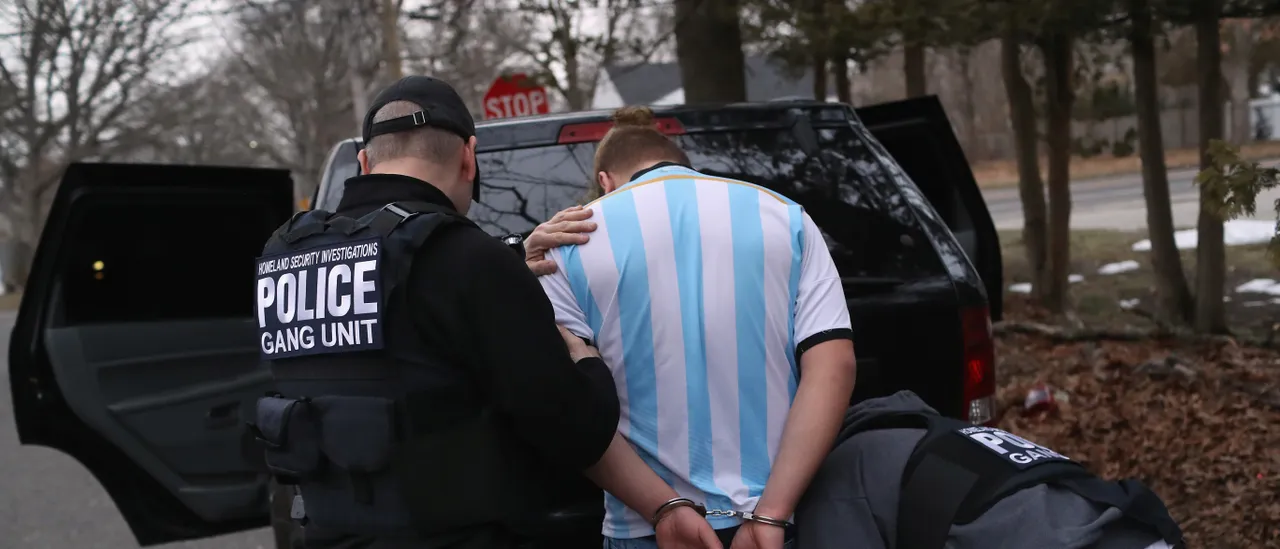
Trump has gone even further in emulating elements of Bukele’s Territorial Control Plan, leading a nationwide crackdown on criminal illegal alien gang members. In late June, the Department of Homeland Security announced it had arrested its 10,000th alleged gang member since the beginning of Trump’s second term — an alleged member of MS-13.
Still, with an estimated 14 million illegal immigrants in the U.S. as of 2023 and roughly 731,000 active gang members as of 2009, the question remains: What can the U.S. learn from El Salvador?
There are several obstacles to directly adopting Bukele’s methods. The U.S. is far larger than El Salvador, making it more difficult to root gang members out of hiding. Trump also lacks the broad electoral mandate Bukele had to crack down on criminal illegal aliens, a divide reflected in the harassment, doxing, protests, and attacks targeting U.S. Immigration and Customs Enforcement (ICE) agents.
It would also be exceedingly difficult for an American president to obtain the kind of prosecutorial leeway Bukele has exercised.
However, the biggest lesson the U.S. can take from El Salvador is to consider what it didn’t do: destroy the gangs before they gained such a powerful hold that the government believed only drastic measures could defeat them.
“We believe in romanticism, we believe in rehabilitation,” Villatoro said. “But in this matter of gangs, terrorists, criminal organizations, we have no mercy, and we will not show it … We are public servants of El Salvador, and we owe our allegiance to the Salvadoran people.”
If you want to learn more, watch the new Daily Caller documentary “Inside CECOT: The World’s Most Dangerous Prison”
Read more Bison Hurls Grandfather Eight Feet Into The Air After Charging Children In Yellowstone National Park











Post Comment