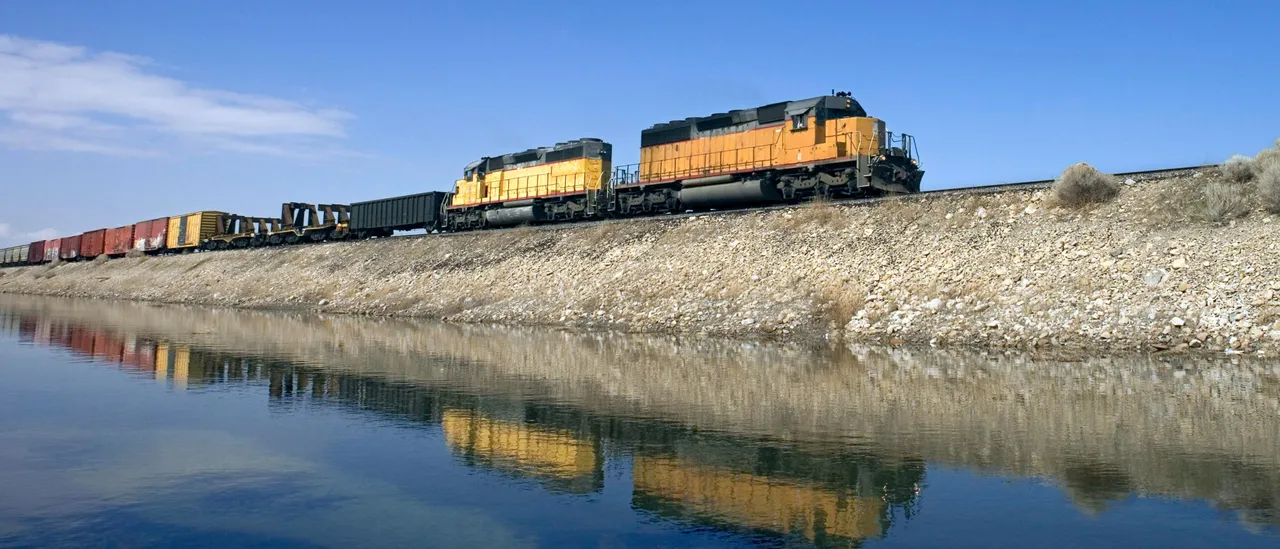
As California Burns Billions To Fail At High-Speed Rail, China Laid Enough Track To Circle America Three Times
Nearly two decades after California and China started their high-speed rail race, China has laid enough high-speed rail to circle the globe — while California’s bullet train has yet to carry a single passenger.
The stark contrast comes as Democratic California Gov. Gavin Newsom announced Friday another $2.7 billion for more than 150 transportation projects across the state while touting progress on California’s high-speed rail system. None of the $2.7 billion announced Friday was identified as funding for the bullet train, which separately secured a $1 billion annual commitment through 2045 from the state’s Cap-and-Invest program.
The Newsom administration did not immediately respond to the Daily Caller News Foundation’s request for comment.
California High-Speed Rail Inspector General Benjamin Belnap recently warned that the California High-Speed Rail Authority (CAHSR) — the state agency overseeing the project — could run out of available funding by December 2027 unless it secures financing, CBS News reported earlier in August. The project faces a $9.5 billion funding gap over five years, according to his office. (RELATED: California’s High-Speed Rail Touts Tiny Savings Amid Epic Cost Explosion)
“The most likely outcome should the Authority not be able to secure financing in 2027 is that it will have to re-prioritize its expenditures to focus on the 119-mile central valley segment currently under construction and will have to limit expenditures on planned extensions into Merced and into Bakersfield,” Amanda Millen, Deputy Inspector General for CAHSR, told the DCNF in a statement.
“This action to align the pace of expenditures with the pace of available funding will significantly delay completion of the 171-mile, Merced-to-Bakersfield initial operating segment, exposing the project to increased inflationary costs,” she added.
China, meanwhile, began its modern high-speed rail push the same year California voters approved their bullet train. The country’s high-speed rail network surpassed roughly 31,000 miles at the end of 2025, according to state-owned China State Railway Group.
But in California, the completed guideway does not even have high-speed rail track installed yet. CAHSRapproved a contractor in June to install the tracks, electrical systems and other equipment needed to turn the Central Valley guideway into an operating railway.
Rather than completing the San Francisco-to-Los Angeles system in 2020 as originally envisioned, rising costs, funding shortfalls and construction delays pushed the project years behind schedule. Officials are now focused on establishing passenger service along the 171-mile Merced-to-Bakersfield segment — roughly one-third the length of the planned 494-mile San Francisco-to-Los Angeles/Anaheim system. The inspector general’s latest review found that service on the shorter segment could be delayed until September 2034.
The U.S.’ comparatively strong system of private property rights makes constructing high-speed rail more difficult than in countries where governments face fewer obstacles to acquiring land and rights of way, Energy analyst David Blackmon told the DCNF.
“High speed rail is much easier to do in countries with weak or non-existent individual property rights,” Blackmon said, pointing to a proposed Dallas-to-Houston high-speed rail project that has encountered its own challenges securing a path forward.
California compounded those inherent difficulties with its regulatory environment and political management of the project, he argued.
“Combine that reality with California’s ridiculously bureaucratic regulatory state and the impulse by politicians like Gavin Newsom to leverage big projects to the benefit of their cronies and the NGOs they ‘manage,’ and you have a witches’ recipe for waste, abuse, and corruption on the grandest scale possible,” Blackmon told the DCNF.
Read more Here Are The Best Colleges For Rural America
California’s problems extend beyond high-speed rail, Stu Turley, CEO of Sandstone Group, similarly argued. He pointed to the state’s energy and environmental policies as examples of what he described as a broader problem of regulation, government intervention and accountability.
“Energy policies across wind, solar, nuclear, oil and gas all have two things in common. The more government overreach, regulatory burden, breeds corruption and higher costs to consumers,” Turley told the DCNF.
Turley pointed to the experience of companies involved in high-speed rail projects overseas. He noted that California’s political and regulatory environment makes infrastructure development unusually difficult compared with foreign countries.
“The Bullet Train disaster run by Gavin Newsom is best summed up by the train company that was hired to build it,” Turley said. “The same train company that built a similar train in Morocco, in under budget and under time.”
“There is zero accountability in California to the rate payers for utilities, services like fire and water, or what happens to all of the tax revenue,” Turley added. “Where did the money go?”
The project’s financial problems intensified after the Trump administration terminated roughly $4 billion in federal funding.
CAHSR sued over the decision but dropped the lawsuit in December 2025, saying the Trump administration was no longer a reliable federal partner. The agency has since turned toward private capital, signing an agreement with a consortium in June to evaluate private investment and public-private partnerships for future expansion.
The high-speed rail project’s problems fit into a broader critique of California’s push toward electrification and its climate goals, Turley argued.
“The electrification of cars and the train were the main drivers to the path of Net Zero, and nothing has been delivered to consumers, except higher prices, and less energy security,” Turley told the DCNF.
China opened its first major modern high-speed line, the Beijing-Tianjin Intercity Railway, in 2008, the same year California voters approved the state’s proposed project.
By the end of 2025, China had put more than 50,000 kilometers of high-speed railway into operation, according to Xinhua News Agency, a Chinese state-run publication.
California voters approved the high-speed rail project in 2008, with plans to connect San Francisco and Los Angeles and complete the system around 2020. Construction began in 2015, seven years after voters approved its first round of funding.
By February 2026, just 80 miles of guideway and 58 structures had been fully completed, while 119 miles of the planned 494-mile Phase 1 route were under active construction. The slow progress came as projected costs ballooned from an initial $33 billion to $45 billion to as much as $135 billion, with the Merced-to-Bakersfield segment alone estimated to cost more than the project’s original budget. Newsom celebrated the completion of a Southern Railhead Facility in Kern County that month, describing it as another step toward laying track.
When voters approved the project, the full Phase 1 system was estimated to cost between $33 billion and $45 billion, but the California High-Speed Rail Authority’s 2026 budget plan put the price tag at roughly $126.2 billion. State auditors have blamed flawed decision-making and poor contract management for billions of dollars in cost overruns and delays, while the project has also faced costly environmental reviews, land acquisition and utility relocation issues.
The Merced-to-Bakersfield initial operating segment alone is now projected to cost roughly $34.76 billion, about as much as the low end of the original estimate for the entire project. California had already spent roughly $15 billion on the project as of March, with only about 2,000 feet of track installed and no high-speed operations underway. The latest plan pushes Merced-to-Bakersfield passenger service to 2033 and completion of the full Phase 1 system to 2040, two decades after the original target.










Post Comment