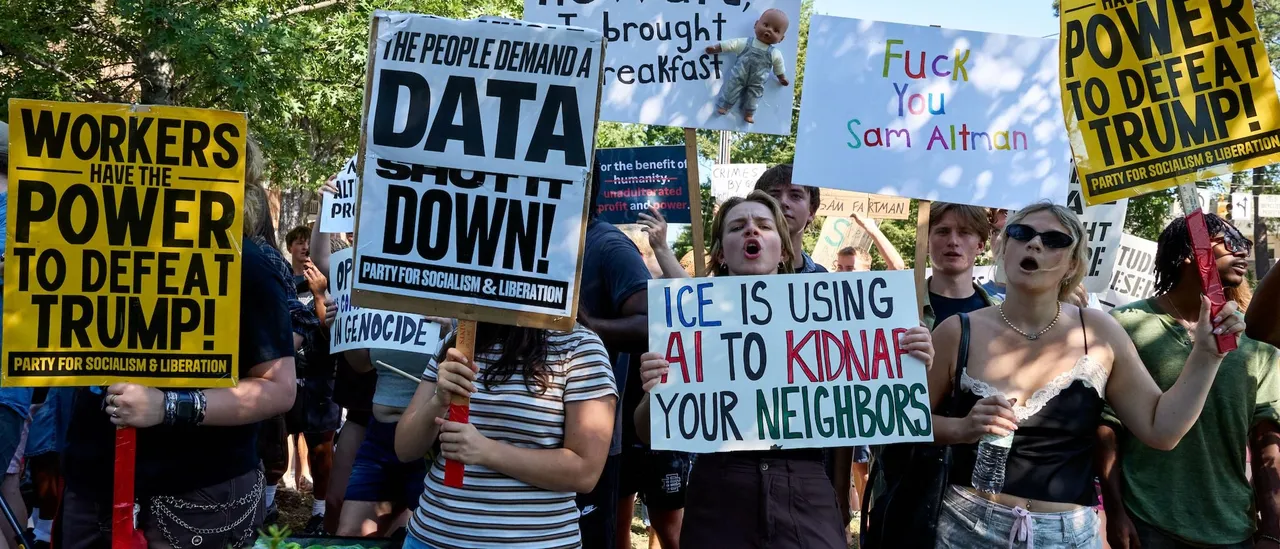
Seems Like Every Single Political Race Centers Around Single Issue Of Data Centers
Data centers are all the rage in the 2026 midterm election cycle. Whether a candidate currently supports or has previously supported data centers and corporate subsidies for AI and tech companies has quickly become a potent attack line in several high-profile races across the country.
Read more Aaron Rodgers Goes After Trump, Says ‘There’s No MAGA Movement’
In two swing-state Senate races, data centers have become a massive issue, leaving several candidates vulnerable to attacks resurfacing their tech-friendly pasts.
Former Democratic Ohio Sen. Sherrod Brown, who once celebrated Amazon Web Services’ investments in Ohio, has attempted to portray his opponent, incumbent Republican Sen. Jon Husted, as “the face of data centers.” Brown has flooded the airwaves with millions of dollars of ads targeting Husted’s previous support for data center tax breaks while he served as Ohio’s lieutenant governor. Husted is now going after data centers and AI companies, accusing them of doing “a terrible job of talking about the value and virtue of it.” (RELATED: Data Center Backlash Brings Thousands of Projects To A Screeching Halt)
“They’ve earned that backlash,” Husted said in late July. “They haven’t been as forthcoming about the benefits that will come in terms of local jobs and construction worker jobs and reduced property taxes, and they haven’t offered things like paying the energy bills for local communities, for the power plants they build.”
The National Republican Senatorial Committee warned in a leaked memo earlier in August that data center politics could sink Husted’s reelection campaign and that “more than any other thing in this race, data centers are the anchor hanging around Husted’s neck.”
Left-wing star Abdul El-Sayed has repeatedly attacked Republican Rep. Mike Rogers throughout the Michigan Senate race. El-Sayed has needled Rogers, joking that the Republican congressman “is a guy who wants to put a data center in your backyard so he can make himself feel a little bit more manly by making an AI video.” Perhaps sensing a shift in political winds, Rogers recently pivoted and endorsed a one-year statewide moratorium on data center construction.
Multiple gubernatorial races have also been influenced by data centers, with candidates sinking millions of dollars into attack ads and forcing opponents to defend, pivot, or reverse completely on the issue.
Pennsylvania’s race, between incumbent Democratic Gov. Josh Shapiro and Republican Stacy Garrity, has turned into a tit-for-tat exchange over who was more supportive of data centers when the issue was not as widely debated among Americans. Shapiro previously courted the industry but has since imposed new restrictions and local-approval requirements. The Pennsylvania Democratic Party went after Garrity in one ad, which cited her saying she would support building data centers in “very rural” parts of the state. Garrity had to go on the defensive.
“Turn on your TV, and I’m sure you’ve seen me, or at least the version of me that Josh Shapiro wants you to see,” Garrity said Tuesday. “The facts. I made a mistake last year. That mistake was believing the words coming out of Josh Shapiro’s mouth. I can assure you that will never happen again. More importantly, I’ve listened to your words and your concerns.”
Read more Tropical Storm Norbert Develops, Expected To Become Hurricane As It Charges Toward Hawaii
In Texas, incumbent Republican Gov. Greg Abbott appears to have backed himself into a corner over his support for data centers in 2025 and is now trying to squeeze his way out. Abbott’s challenger, Democratic state Rep. Gina Hinojosa, has heavily leaned into the issue, running anti-data center ads in rural Texas counties attacking Abbott. Many rural, conservative Texans have expressed their disapproval of Abbott’s approach to data centers and believe the governor is insincere as he makes efforts to backtrack on the issue. (RELATED: Longtime Conservatives In Red State Consider Unthinkable: Voting For Democrat)
Heavy ad spending in Georgia’s race between former Biden senior adviser Keisha Lance Bottoms and the business-friendly Republican Rick Jackson has brought the data center issue into the spotlight. As the former Atlanta mayor, Bottoms backed AI infrastructure projects, but won her Democratic primary after hinting that she would halt construction of AI server hubs, according to Politico. Jackson is an investor in a data center project in Texas and has tried to portray data centers as an economic opportunity for rural communities.
Republican Rep. Byron Donalds, the GOP’s nominee for Florida governor, spent $2 million on a single ad in which he vowed to protect the state from data centers that “jack up utility rates.” In one of his first ads in the general election, Donalds’s opponent, Democrat David Jolly, said he doesn’t want crime or data centers “in our neighborhoods.” Jolly said he supports a one-year moratorium on data center construction to study their effects. Donalds has taken a different approach, recently outlined in an exclusive Daily Caller interview Sept. 9.
“My position is, if you’re not going to protect our resources and you’re not going to protect people’s utility bills, then no data centers. But local governments have the final say in Florida,” he told the Caller. (RELATED: EXCLUSIVE: Byron Donalds Threads The Needle On Data Centers, Backs Tough Action On Flock)
In Wisconsin, Democratic nominee David Crowley and his Republican opponent, Tom Tiffany, are both trying to frame each other as more pro-data center. Crowley has said he opposes a total state moratorium on data centers, favoring local control, stricter guardrails and more transparency. Here, Tiffany agrees. But the two candidates differ on the issues of tax breaks and corporate subsidies. Whereas Crowley wants to force data center developers to hit certain benchmarks before enjoying the benefits of a tax break, Tiffany wants to get rid of all subsidies for data centers.
“These are some of the wealthiest companies in the world, and the people of Wisconsin should not be subsidizing them,” Tiffany said in a statement.
The Republican has spent millions on ads that dub his opponent “Data Center David Crowley.”
Read more The Democrats’ New Normal: Ashley Madison And Masculinity Struggle Sessions










Post Comment